Books
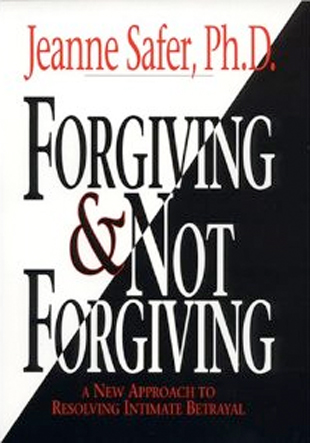
Forgiving and Not Forgiving
Why Sometimes It's Better Not to Forgive
In our culture the belief that “To err is human, to forgive divine,” is so prevalent that few of us question its wisdom. But do we ever completely forgive those who have betrayed us? Aren’t some actions unforgivable? Can we achieve closure and healing without forgiving? Drawing on more than two decades of work as a practicing psychotherapist, more than fifty indepth interviews, and sterling research into the concept of forgiveness in our society, Dr. Jeanne Safer challenges popular opinion with her own searching answers to these and other questions. The result is a penetrating look at what is often a lonely, and perhaps unnecessary, struggle to forgive those who have hurt us the most and an illuminating examination of how to determine whether forgiveness is, indeed, the best path to take–and why, often, it is not.
I recently read your book “Forgiving and Not Forgiving.” Unforgivers who have rational, healthy, valid and moral reasons for not forgiving do need to be recognized.…Reading your book was like having a conversation with an intelligent, rational friend. Thank you.
“The permission not to forgive is such a lone voice in the forgiveness wilderness”
-Dr. Anne Hallward, Safe Space Radio
It is my moral obligation not to forgive Osama bin Laden.
-Jeanne Safer, Phd, USA Today
There is no one-size-fits-all solution to crimes of the heart.
-Jeanne Safer Phd, Letter to the Editor of The New York Times
“Jeanne Safer offers a brave and compassionate voice on a taboo subject with insight and clarity. Memorably engrossing, this book offers support and guidance to an often bewildering human emotional process.”
-Susan Forward, PhD
“A lucid, literate and highly original work…This is a wonderfully readable book; there are nuggets of wisdom to be found on every page.”
-Maggie Scarf
A 20/20 segment broadcast in early January: As the uplifting music swells, the avuncular announcer intones “And now here’s a resolution for the New Year we should all make—forgiveness.” We see a mother and daughter estranged for years kiss and make up, a couple after just a few sessions of “forgiveness therapy” (all previous marriage counseling had failed) holding hands and renewing their vows. Amid the gauzy backgrounds, the inevitable tears flow, the inevitable hugs proliferate, and the inevitable psychological experts stop just short of claiming that failure to forgive causes cancer and heart disease. They say traditional psychotherapy has neglected this essential element of cure and that studies show that forgiving alleviates depression and enhances self-esteem.
Several weeks later, on Good Morning America: A rabbi asserts that “forgiving is like taking a poison out of your body,” and a priest agrees that, otherwise, “evil is recycled.”
Politicians caught in scandalous behavior make public displays of contrition and speak poignantly of how their ordeals have taught them the importance of not only asking forgiveness, but of granting it to their accusers.
What’s wrong with this picture?
All the hype is not entirely inaccurate. We all know people (often in our own families) who haven’t spoken to one another for so long that they have forgotten what they were angry about, couples whose mutual resentments are etched on their faces, acquaintances so obsessed with hating or plotting revenge on their enemies that they have alienated us. I have treated many patients like them in my twenty-five years as a psychotherapist. But don’t we also know others—mature, even wise people—who passionately refuse to forgive wrongs, or who feel, despite their best efforts, that they cannot without doing violence to themselves? Has failure to forgive destroyed their ability to love?
Forgiving and Not Forgiving proposes a paradigm shift. It challenges the conventional wisdom and offers a new and consoling perspective: that forgiveness as it is commonly understood is only one of many routes to resolution, humanity, and peace and that reengaging with the past is the best was to change the future. It charges that false forgiveness damages self and society, and that not forgiving without vindictiveness can be morally and emotionally right.
The capacity to forgive is an essential part of an examined life. However, enshrining universal forgiveness as a panacea, a requirement, or the only moral choice, is rigid, simplistic, and even pernicious. Forgiveness by the numbers leads too frequently to emotional inauthenticity—a condition rampant in contemporary America.
Everybody has something to forgive—parents who failed, lovers who left, friends who deceived, and—often the hardest of all—our own actions. (Crimes by strangers are not intimate betrayals because they do not violate a personal relationship with the victim and will not be considered here.) Though it is a cornerstone of the Judeo-Christian tradition, forgiveness is not “natural,” or religion and society would not have to lobby so hard to get people to do it; the reflexive reaction to being hurt is hatred, outrage, and the desire for revenge. While forgiveness is not always necessary or possible, coming to terms with intimate betrayal is, and that is what this book is about.
There is no author interview for this book.
There are currently no upcoming events related to this book.
For a comprehensive list of past speaking engagements please click here.
I recently read your book “Forgiving and Not Forgiving.” Unforgivers who have rational, healthy, valid and moral reasons for not forgiving do need to be recognized.…Reading your book was like having a conversation with an intelligent, rational friend. Thank you.
“Dear Dr. Safer,
I just found you online and immediately ordered three of your books (The Normal One, Forgiving and Not Forgiving, and Death Benefits). Just reading your website has provided more validation than a lifetime of therapy and support by extended family and friends.”
“I just finished reading your wonderful book, Forgiving & Not Forgiving, for the second time. Again, I found what you had to say profound and applicable to my life. As I find my way through intimate betrayal, you helped me keep on my path of doing it my way. I marked nearly every page of your book and found myself re-reading long passages. Each time, I say, ‘Yes! Someone gets it!’ Thank you for your brave candor then and for your helpful insights now.”
“I watched your interview on “Insight” on Australian television recently and was so impressed with your frank and honest approach to ‘forgiving’ that I asked my bookstore to find me a copy of your book Forgiving and Not Forgiving. I am now feeling free for the first time in my life. Your TV interview and the book have come at a perfect time for me. I have read some chapters three or four times, and each time, get more from it.”
Buy the Book